
informational 7 min read
Cenote Cave Diving: The Pit, Angelita, Chac Mool and Who Can Go
Updated October 27, 2026
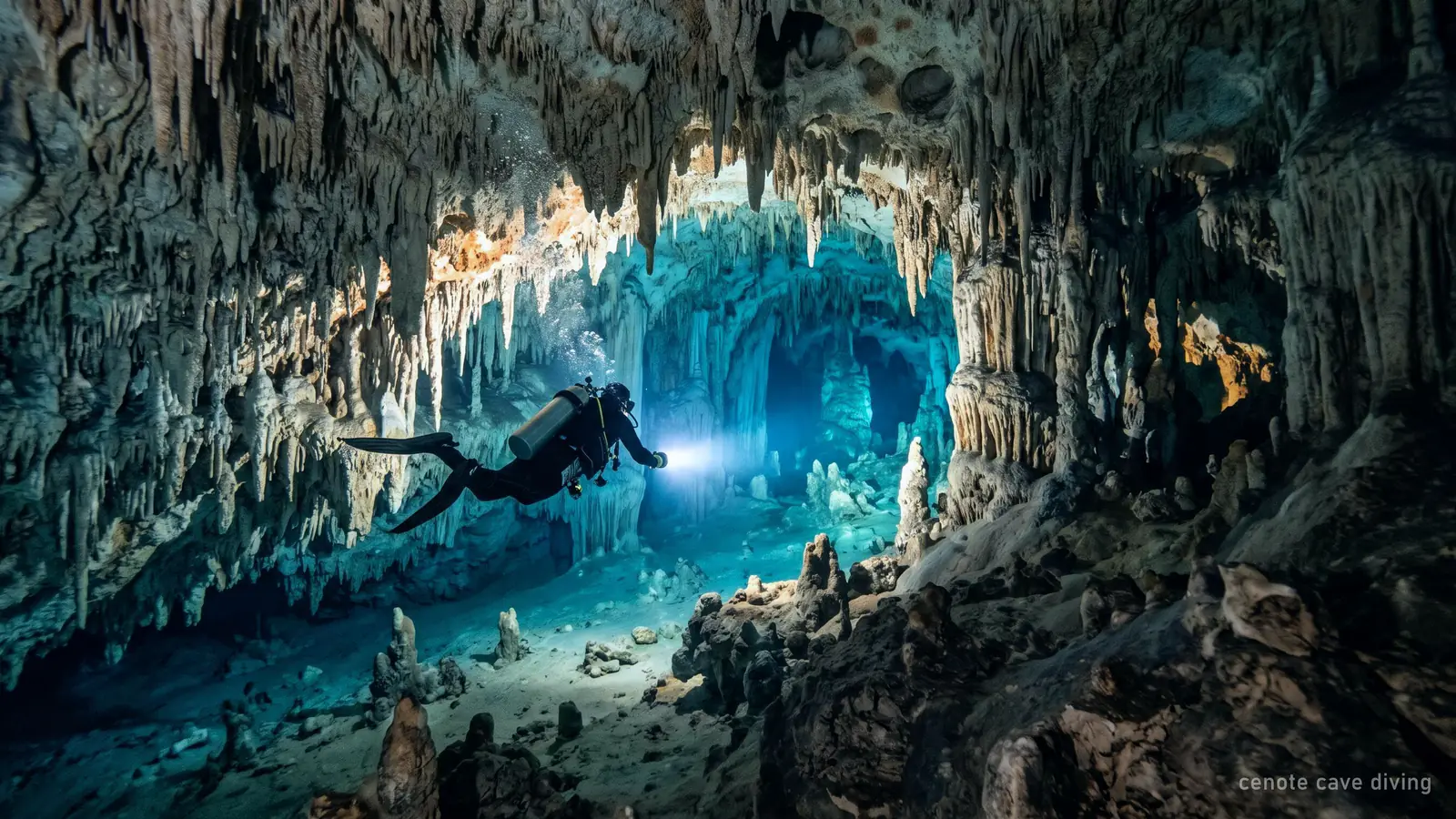
Cave diving in the cenotes means swimming beyond the reach of daylight, and only divers with full cave training do it; the cenote dives sold to visitors are cavern dives that stay where you can still see the way out. The famous named dives near Tulum and Playa del Carmen (The Pit, Angelita, Chac Mool and Chikin Ha) are all done as guided cavern dives. Each dive centre sets its own entry level: Open Water for the shallow ones, Advanced Open Water for the deep ones.
Cavern vs cave diving
The difference is light. Wikipedia’s cave diving article defines cavern diving as diving in the naturally lit part of a cave, where the exit is visible. It says recreational agencies typically set limits of about 30 m (100 ft) depth and about 60 m (200 ft) of penetration.
Cave diving goes past that point. The same article calls it technical diving: you follow a continuous guideline, carry redundant lights and plan your gas. Training generally runs in four steps: Cavern, Intro to Cave, Apprentice, Full Cave. The NSS Cave Diving Section, a US cave diving body, has existed since 1974, with Sheck Exley as its first chairman.
| Cavern diving | Cave diving | |
|---|---|---|
| Light | Natural light, exit in sight | Beyond daylight |
| Limits | About 30 m deep and 60 m in (Wikipedia, citing recreational agencies) | Set by your cave training |
| Training | Open Water or Advanced, with a cavern guide | Intro to Cave, Apprentice, Full Cave |
| Equipment | Standard scuba gear plus a lamp | Guideline, redundant lights, gas plan |
| How visitors book it | Two-dive day with a dive centre | Not sold as a tour |
Exley’s 1979 accident study, “Basic Cave Diving: A Blueprint for Survival”, produced five rules: training, a continuous guideline to the exit, depth limits, gas management by thirds and at least three lights. Wikipedia says failing to use a guideline is the most frequent cause of death among untrained divers, and that most cave diving deaths come from running out of gas, often after getting lost.
Why the cenotes draw cave divers: the caves under the Riviera Maya are some of the longest known. Wikipedia’s Sistema Sac Actun page says the system has 228 cenote entrances and, as of January 2023, was the second-longest surveyed underwater cave system after Sistema Ox Bel Ha (435.8 km). The Dos Ojos system was linked to Sac Actun in January 2018. See Cenote Sac Actun.
The Pit
The Pit is a deep shaft inside the Dos Ojos park, north of Tulum. Wikipedia’s Dos Ojos page gives its depth as 119.1 m (391 ft), the deepest known cave passage in Quintana Roo, discovered in 1996 about 1,500 m from the main entrance. One travel guide gives 118 m.
On a recreational dive you see the top part. Scuba Tulum’s dive page says sun rays reach about 30 m, where they meet a thin white hydrogen sulphide cloud at the halocline. It asks for Advanced Open Water plus the Deep Diving specialty, a dive within the last year, and a minimum age of 15. The cenote fee for The Pit and Dos Ojos on that page is 600 pesos (MXN).
Agua Clara Diving Tulum is stricter: Advanced Open Water, a dive in the last six months, deep and cavern experience, and a minimum age of 16. Its cenote fee for The Pit and Dos Ojos is 900 pesos in cash, not included in the dive price. See Cenote Dos Ojos.
Angelita’s hydrogen sulphide cloud
Cenote Angelita is about 17 km south of Tulum, a five-minute walk in, per Showcaves. Its draw is a white layer of hydrogen sulphide that hangs in the water like a cloud, around a small island of trees, per Scuba Tulum.
The cloud sits on the halocline, the boundary where fresh water floats on heavier salt water. Showcaves puts the halocline at 33 m and the cenote’s depth at about 60 m, with dives to about 40 m. That page dates its information to 2008 and asks for Advanced certification and at least 20 logged dives.
Scuba Tulum’s current dive page describes a descent to about 30 m and sets a maximum of 33 m (100 ft). It asks for Advanced Open Water or higher, a dive within the last year and a minimum age of 15. Its cenote fee is 400 pesos.
SSI, a training agency, also lists Angelita for freediving: about 60 m deep, advanced only, halocline at about 30 m.
Chac Mool and Chikin Ha
These two are near Playa del Carmen and Puerto Aventuras, not Tulum. They are shallower and are often a diver’s first cenote.
Chikin Ha. Deep Mexico gives a maximum depth of 10 m (30 ft), for Open Water or Advanced divers. Its two-dive package costs MX$3,400 (about $183 at 18.5913 pesos to the dollar), with entrance fees included.
Chac Mool. Xico Dive Center sells two dives at Chac Mool, Dos Ojos or Chikin-Ha for MX$3,800 (about $204), with transport and the cenote fee. Deep Dive Mexico lists two dives at Chac Mool from €140 and sets a minimum age of 18 there. We could not open a source for Chac Mool’s depth, so we do not give one.
Hells Bells at Zapote
The fourth named dive is on the Ruta de los Cenotes near Puerto Morelos. Wikipedia says the Hells Bells in Cenote Zapote are hollow bell-shaped rock formations up to more than 2 m long, at 29 to 35 m (95 to 115 ft), in a cenote 54 m (177 ft) deep. They stop growing downward at the halocline. The Quintana Roo tourism portal says they are for certified divers only. See Cenote Zapote.
What cave divers have found
Cave diving here is also archaeology. Reuters reported in 2018 that the Sac Actun system holds about 200 archaeological sites, about 140 of them Maya, and Mexico’s INAH said the caves preserved remains of extinct ice-age animals when the sea rose about 100 m at the end of the last ice age.
The best-known find is in Hoyo Negro, a deep chamber explored in March 2008. Wikipedia’s Sac Actun page records a mastodon at 60 m and a human skull at 43 m from a teenage girl named Naia. In another Quintana Roo cave, the “Eve of Naharon” skeleton found in 2001 and 2002 was carbon-dated to about 13,600 years old, per Wikipedia.
Two practical points apply on every cenote dive. Wikipedia’s cenote article notes that fresh water changes your buoyancy, so you need different weights than in the sea, and that crossing the halocline blurs your vision.
Who can go
| Dive | Max dive depth | Entry level | Set by |
|---|---|---|---|
| Dos Ojos cavern | 10 m | Open Water, dived in last year, age 15+ | Scuba Tulum |
| Dos Ojos cavern | about 5 to 10 m | Open Water | Mexidivers |
| The Pit | cloud at about 30 m | Advanced Open Water + Deep specialty, age 15+ | Scuba Tulum |
| The Pit + Dos Ojos | not stated | Advanced Open Water, dived in last 6 months, age 16+ | Agua Clara Diving |
| Angelita | 33 m | Advanced Open Water, age 15+ | Scuba Tulum |
| Chikin Ha | 10 m | Open Water or Advanced | Deep Mexico |
| Chac Mool | not sourced | age 18+ | Deep Dive Mexico |
| Ki Ha + Zapote (listing spelling) | not stated | Advanced Open Water, or Open Water with 20 logged dives | GetYourGuide listing summary |
If you want the cavern card itself, PADI’s course page says the PADI Cavern Diver course requires Advanced Open Water and a minimum age of 18, and keeps you within the light zone. Going further needs cave training on top.
Book a cavern dive
Most visitors book a two-dive day with a dive centre in Tulum or Playa del Carmen, or a listing with hotel pickup from Cancún. Our cenote diving tours guide compares prices from six dive centres and two pickup listings, from about $160 for two dives. If no one in your group dives, the cenote tours from Cancún are swim and snorkel days that need no card.
Frequently asked questions
Is cenote diving cave diving?
Usually not. The guided cenote dives sold to visitors are cavern dives that stay where daylight shows the exit. Cave diving goes past the daylight and needs full cave certification.
How deep is The Pit?
Wikipedia gives 119.1 m (391 ft), the deepest known cave passage in Quintana Roo, found in 1996. Recreational dives go nowhere near the bottom: Scuba Tulum's description has divers meet the hydrogen sulphide cloud at about 30 m.
What is the cloud in Cenote Angelita?
A layer of hydrogen sulphide that sits on the halocline, where fresh water floats on salt water. Showcaves puts the halocline at 33 m; Scuba Tulum describes reaching the white cloud at about 30 m.
What certification do I need to dive Angelita or The Pit?
Scuba Tulum asks for Advanced Open Water for Angelita, and Advanced Open Water plus the Deep Diving specialty for The Pit. Agua Clara Diving asks for Advanced Open Water, a dive in the last six months and deep and cavern experience for The Pit.
Can I cave dive without cave certification?
No. Cave diving beyond the light zone is for divers with cave training, which usually runs Cavern, Intro to Cave, Apprentice and Full Cave. Without it, you can join a guided cavern dive.
Sources