
informational Pillar guide 8 min read
What Is a Cenote? The Sinkhole, the Word and the Water
Updated October 27, 2026
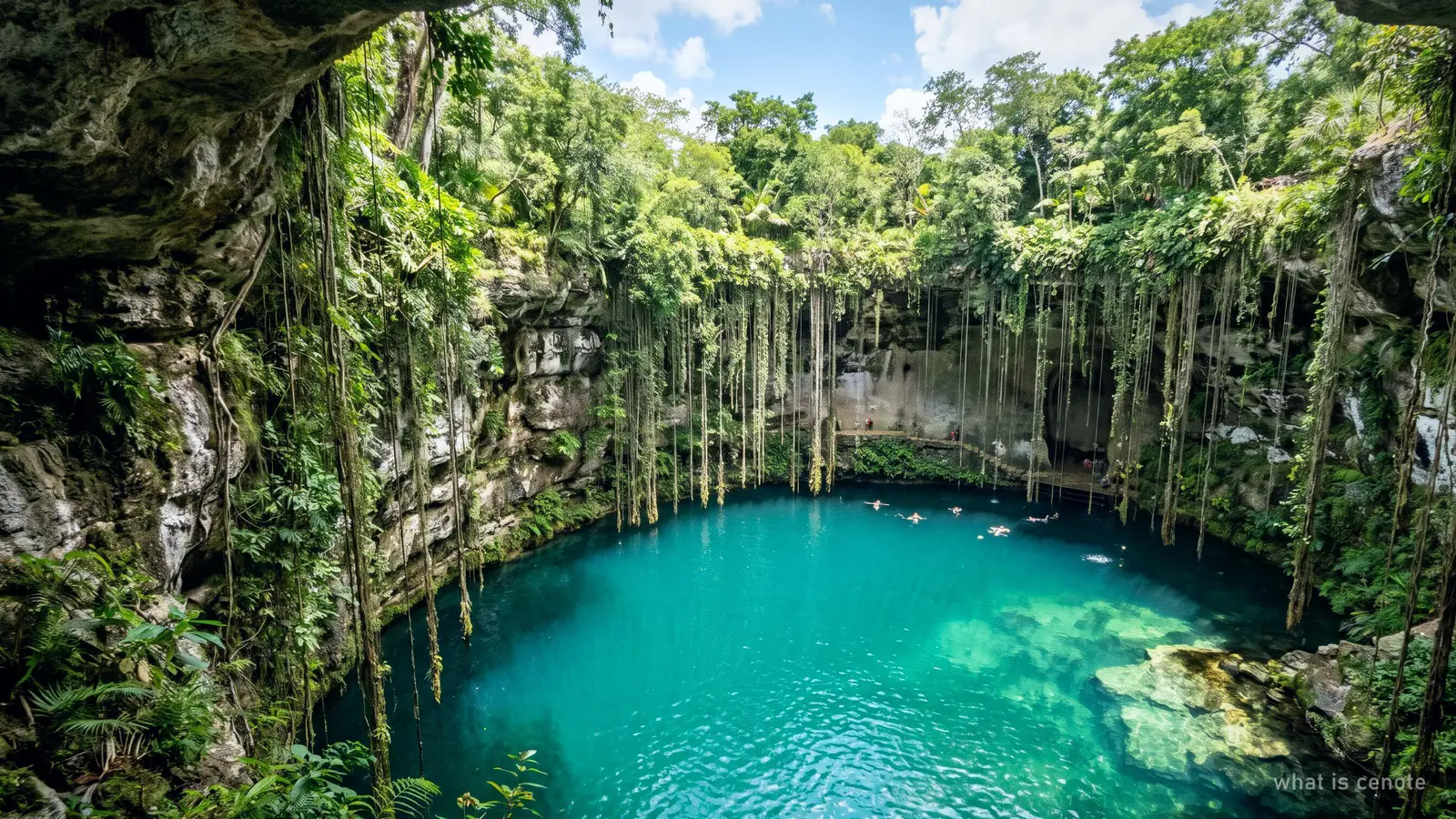
A cenote is a natural pit or sinkhole formed when limestone collapses and exposes the groundwater beneath it. In the Yucatán Peninsula, where Cancún sits, they are the openings to an underground water system: the north of the peninsula has no rivers above ground. Some are open pools under the sky, some are half-covered, and some are caves with a hole in the roof. They range from a few metres to more than 100 m deep, and estimates of how many there are run from 6,000 to over 10,000.
The definition
Wikipedia defines a cenote as “a natural pit, or sinkhole, resulting from the collapse of limestone bedrock that exposes groundwater underneath”. The water is fresh near the surface. Below it, in many cenotes, lies a layer of salt water that has seeped in from the sea. Where the two meet, at a boundary called the halocline, the water shimmers and blurs.
The Yucatán Peninsula covers about 181,000 km² (70,000 sq mi) of flat limestone, per Wikipedia. Rain sinks into the rock instead of running off in rivers. Cenotes are where the roof over that hidden water has fallen in. For the step-by-step geology, see how cenotes formed.
The word
“Cenote” comes from the Yucatec Maya word ts’ono’ot, sometimes written tz’onot. Wikipedia says the Maya used it for any place with accessible groundwater. Por Esto, a Yucatán newspaper, glosses it as “deep thing”, “abyss” or “depth”. The Spanish turned it into cenote, and English borrowed the Spanish word. In English it is usually explained as a sinkhole or a natural well.
Open, semi-open and cave cenotes
Visitors usually sort cenotes into three types by how much of the water you can see from above. Yucatan Today uses the same three.
| Type | What it looks like | Examples near Cancún |
|---|---|---|
| Open | A pool or small lake open to the sky | Ik Kil, Casa Cenote, Cenote Azul |
| Semi-open | Partly roofed; light falls through a large opening | Gran Cenote, Cenote Zací, Cenote Calavera |
| Cave (closed) | Under a rock roof, lit by a small hole or lamps | Suytun, Chaak Tun, Rio Secreto |
Geologists use a finer system. Frank Hall’s 1936 classification, cited by Wikipedia, has four types: jug-shaped (a narrow mouth over a wider chamber), open with near-vertical walls, shallow basins, and cave-like entrances leading to water. Wikipedia says the cave-like type is the most common in Quintana Roo, the state Cancún is in, and the one most popular with tourists.
Yucatán state’s own census, cited in its Decree 193/2014, counted 2,241 cenotes and caves: 1,014 open, 342 semi-open, 734 closed, and 151 grottoes.
How deep cenotes are
There is no typical depth. A few figures from sourced pages:
- Dos Ojos, north of Tulum: the snorkel area reaches about 10 m (33 ft), per a Tulum guide. Inside the same cave system, The Pit reaches 119.1 m (391 ft), the deepest known cave passage in Quintana Roo (Wikipedia).
- Ik Kil, near Chichén Itzá: about 48 m (157 ft) deep, with the water about 26 m below ground level (Wikipedia).
- Cenote Zapote, near Puerto Morelos: 54 m (177 ft) deep (Wikipedia, Hells Bells page).
- Angelita, south of Tulum: about 60 m, per Showcaves.
- Zacatón, in Tamaulipas in northeast Mexico: 339 m (1,112 ft) in total, 319 m of it underwater, measured by a NASA-backed robot. Wikipedia calls it “one of the deepest known water-filled sinkholes in the world”, not the deepest.
You swim only in the top few metres. The deep parts are for divers, and the deepest only for cave divers. See cenote diving.
Why the Yucatán has thousands
Counts conflict, because nobody has mapped them all. Here are the published figures, with whose they are:
| Area | Figure | Source |
|---|---|---|
| Yucatán Peninsula | about 10,000 (estimate) | Wikipedia, citing Time (2023) |
| Yucatán Peninsula | at least 6,000 | Wikipedia (weaker source) |
| Yucatán Peninsula | over 10,000, about 2,400 recorded | Yucatan Today (January 2026) |
| Yucatán state | 7,000 to 8,000 estimated; 3,050 on the state register | Por Esto (August 2026) |
| Yucatán state | 2,241 cenotes and caves | State census cited in Decree 193/2014 |
| Quintana Roo | more than 3,500 | Por Esto (July 2025), no official source cited |
So: several thousand on record, and perhaps 10,000 in all. Wikipedia says the eastern side of the peninsula, where Cancún and Tulum are, has more cenotes, scattered more randomly, because its limestone is more fractured and permeable. In the west they line up in the Ring of Cenotes over the Chicxulub crater. The formation guide explains both.
What is in the water
Cenote water is often very clear. Wikipedia says that is because it is rain filtered slowly through the ground, with little suspended matter. In cave-linked cenotes it can flow up to 10 km (6 mi) a day. The temperature stays at about 24 to 25 °C (75 to 77 °F) all year, per Wikipedia and Yucatan Today.
Life is small but present. Wikipedia says the fish at Dos Ojos are mostly well under 10 cm, with at least two kinds of freshwater shrimp, and that bats depend on cenotes: one species, Pteronotus personatus, has been recorded only in cenote habitat. Tulum guides report turtles at Gran Cenote and a resident crocodile at Casa Cenote.
What makes them special
For the Maya, cenotes were the main source of water, and cities such as Chichén Itzá grew around them. Wikipedia says the Maya saw them as portals to Xibalba, the underworld, and home of the rain god Chaac. Offerings and human remains have been found in some, such as the Sacred Cenote at Chichén Itzá, but not all were sacrificial sites. More on what cenotes were used for.
The caves under them are also among the longest known. Wikipedia’s Sistema Sac Actun page says that system, near Tulum, has 228 cenote entrances and, as of January 2023, was the second-longest surveyed underwater cave system in the world.
See one near Cancún
Cancún does have cenotes of its own. A local research centre, CICY, has identified 77 inside the city, and a municipal programme has removed more than 30 tonnes of waste from them since 2024. But no source we read describes any of them as open for swimming. The cenotes visitors swim in are outside the city, within a day trip:
- Ruta de los Cenotes, a road of about 35 km running inland from Puerto Morelos to Leona Vicario, with cenotes such as Siete Bocas, Verde Lucero, Kin-Ha and Zapote. Zapote is about 36 km south of Cancún, per Wikipedia. See the Ruta de los Cenotes.
- Tulum, where Gran Cenote and Dos Ojos open onto the Sac Actun cave system, plus Calavera and Casa Cenote.
- Chichén Itzá and Valladolid, in Yucatán state: Ik Kil, Suytun, Zací, and the Sacred Cenote, which you see from its rim but cannot swim in. Our ranked list of cenotes near Cancún sorts them by drive time and type. If you would rather not drive, the cenote tours from Cancún include transport, from a cenote swim day at $59 to Chichén Itzá with a cenote stop from $57.
Frequently asked questions
What is a cenote in simple words?
A natural hole in the ground where the limestone roof of a cave has fallen in, leaving a pool of fresh groundwater you can often swim in.
What does cenote mean in Spanish and English?
Cenote is the Spanish form of the Yucatec Maya word ts'ono'ot (also spelled tz'onot), which meant any place with reachable groundwater. In English it is usually explained as a sinkhole or natural well.
How deep are cenotes?
From a few metres to well over 100 m. Ik Kil is about 48 m deep, The Pit in the Dos Ojos system reaches 119.1 m, and Zacatón in Tamaulipas, which Wikipedia calls one of the deepest known water-filled sinkholes, measures 339 m in total.
How many cenotes are there?
Nobody has a complete count. Estimates for the Yucatán Peninsula range from at least 6,000 to about 10,000 (sources cited by Wikipedia), and Yucatán state alone has 3,050 on its register (Por Esto, 2026).
Why is cenote water so clear?
It is rainwater that has filtered slowly through limestone, so it carries little suspended matter, Wikipedia says. In caverns, visibility is limited more by light than by the water.
Are there animals in cenotes?
Yes, mostly small ones: fish well under 10 cm and freshwater shrimp at Dos Ojos (Wikipedia), turtles at Gran Cenote, and bats in many caverns. Casa Cenote has a resident crocodile, per Tulum guides.
Sources